The Never Again Journal · Cultural Preservation
When the written word became a nation’s inheritance
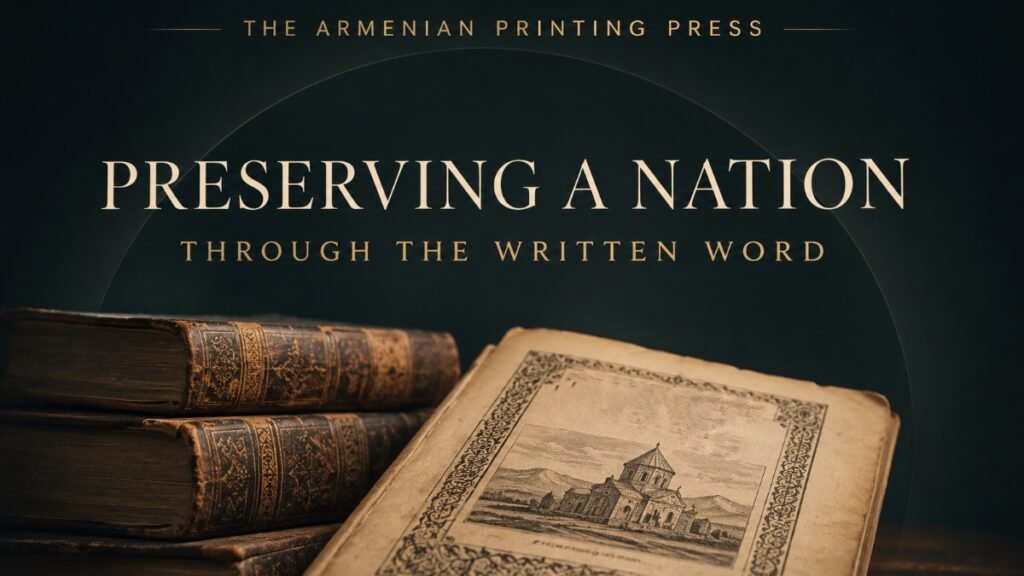
Across centuries of displacement, foreign rule and persecution, Armenian books carried a language, a history and a collective identity beyond the boundaries of any empire.
From the earliest Armenian printed books in Venice to the literary circles of Constantinople, generations of printers, publishers and writers built an extraordinary intellectual heritage. Their work connected communities across continents and preserved knowledge that would otherwise have been lost.
01 / Origins
Venice, 1512: A new chapter in Armenian history
Long before the arrival of printing, Armenian scribes preserved religious texts, historical chronicles, poetry and scientific knowledge through the painstaking production of manuscripts. Their work sustained a written tradition rooted in the Armenian alphabet developed by Mesrop Mashtots in the early fifth century.
In 1512, Hakob Meghapart published the Urbatagirk (Book of Friday) in Venice, generally recognized as the first printed Armenian book. Printing introduced a new means of transmitting Armenian knowledge: multiple copies could circulate among readers separated by vast distances.
The printed book did not replace the manuscript tradition overnight. Instead, it extended the reach of Armenian letters, carrying inherited knowledge into new communities and creating opportunities for new forms of scholarship.
02 / Intellectual heritage
A literary world without borders
Armenian printing developed across a remarkable network of cities, including Venice, Amsterdam, Constantinople, Madras and Smyrna. Merchants, clergy, educators and publishers helped sustain the circulation of books and ideas across Europe, Asia and the Ottoman Empire.
In Amsterdam in 1666, the printing of the Armenian Bible under the direction of Voskan Yerevantsi marked another major achievement. In Madras in 1794, Azdarar emerged as the first Armenian periodical, demonstrating how print could connect dispersed Armenian communities through news and public discussion.
By the nineteenth century, Constantinople had become a major centre of Western Armenian literature and journalism. Newspapers, literary journals, textbooks and novels gave readers access to new ideas about education, social reform and national identity. Writers including Hagop Baronian, Krikor Zohrab, Zabel Yesayan and Daniel Varoujan enriched this intellectual landscape through satire, fiction, essays and poetry.
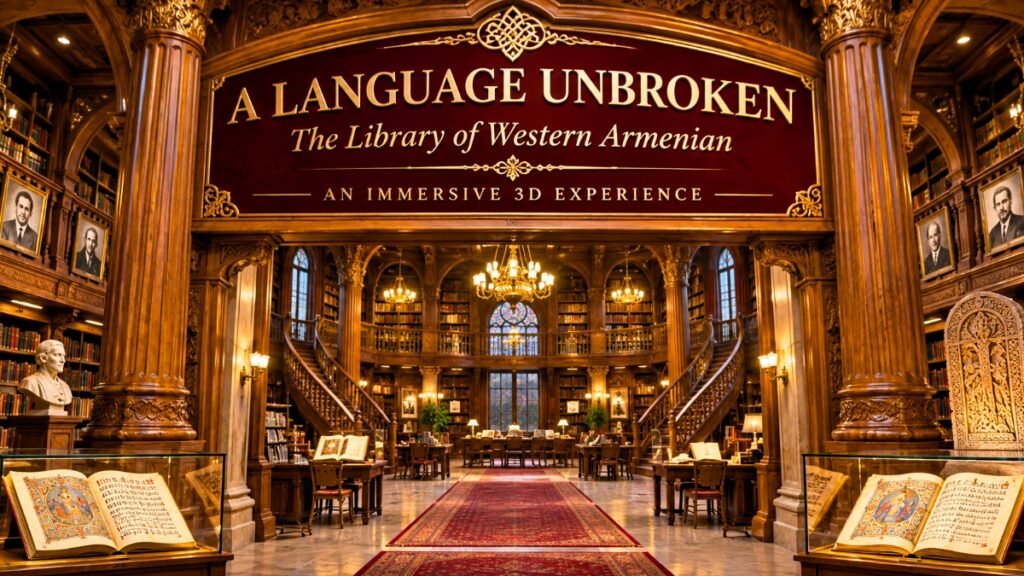
Discover this cultural world through Exhibit I — A Language Unbroken, where Armenian language, literature and printing are explored together.
03 / Cultural destruction
When the voices of a generation were silenced
On April 24, 1915, Ottoman authorities began arresting Armenian intellectuals and community leaders in Constantinople. Among those targeted were writers, editors, physicians, educators and other figures whose work had helped shape Armenian public life.
The Armenian Genocide of 1915–1923 destroyed communities, uprooted families and devastated the institutions that sustained Armenian cultural life. Schools, libraries, churches and publishing networks were disrupted or destroyed. Alongside the murder of 1.5 million Armenians came an immense loss of manuscripts, books, personal archives and intellectual continuity.
Yet surviving publications preserve the voices of people whose lives and communities were taken. Their words remain a connection to the Armenian world that existed before 1915.
- 1512 Hakob Meghapart publishes the Urbatagirk in Venice.
- 1666 The Armenian Bible is printed in Amsterdam.
- 1794 Azdarar begins publication in Madras.
- 1915 The arrests of Armenian intellectuals mark a devastating rupture in Armenian cultural life.
04 / Continuity
The responsibility of preserving what endured
For descendants of survivors, an Armenian book can represent far more than a literary work. Its language, spelling and expressions preserve connections to family histories, lost towns and communities scattered across the world.
Western Armenian literature is particularly important in this regard. Its preservation requires not only safeguarding original editions but also ensuring that future generations can read, hear, understand and engage with the language in which those works were written.
The Armenian Genocide Museum of Canada brings these strands of cultural heritage together through its exhibitions, historical collections and educational experiences. Within the Library of Western Armenian, visitors can explore original literary works, listen to historical testimony and discover interactive language-learning activities.
The preservation of Armenian literature belongs alongside the remembrance of the Genocide. It allows us to encounter the richness of Armenian life before its destruction and to recognize the enduring cultural legacy carried forward by survivors and their descendants.
A Language Unbroken
Enter a library where the written word lives on
Walk through the Library of Western Armenian, discover the works of prominent Armenian authors and explore the language that generations have carried across borders.
Continue your exploration