In the Media / Education and Historical Memory
Beyond the recording.
A conversation with memory.
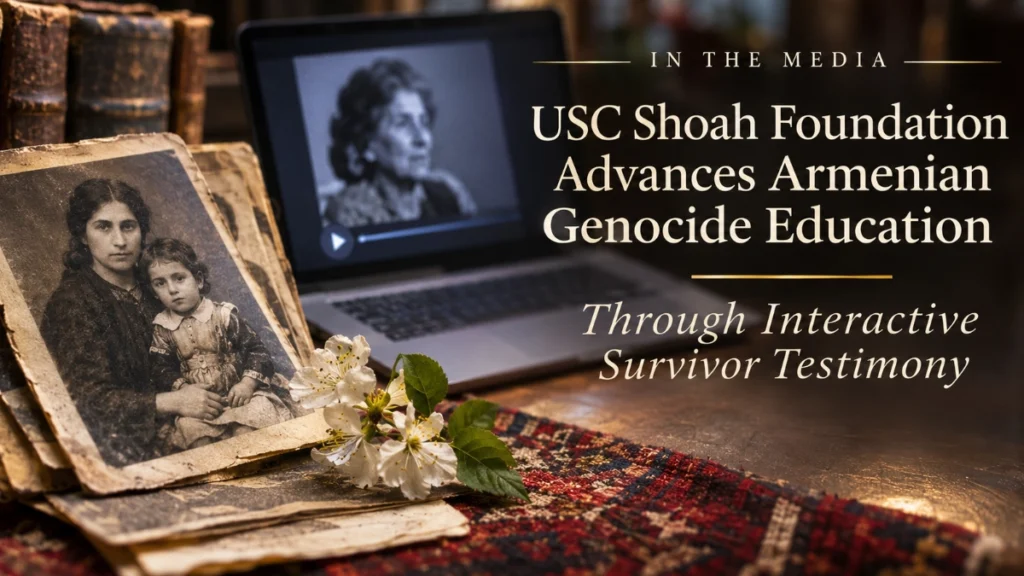
Interactive biographies are opening new possibilities for Armenian Genocide education, connecting students with the experiences of survivor descendants through recorded personal accounts and digital technology.
Media source: The California Courier · November 20, 2026.
Read the original report01 / What is new
Bringing Armenian Genocide history into the digital classroom
A November 20, 2026 report in The California Courier highlights an upcoming educational programme at the Armenian Museum of Fresno, featuring the USC Shoah Foundation and Avenues for Change: Holocaust and Genocide Education.
Scheduled for December 3, the programme will introduce teachers and community members to educational resources that bring the personal histories of Armenian Genocide survivors and their descendants into contemporary learning environments. Among the resources being demonstrated are interactive biographies developed through the USC Shoah Foundation’s Armenian Genocide education initiative. [1]
The programme will feature Dr. Sedda Antekelian of the USC Shoah Foundation and Hilary Levine of Avenues for Change.
For educators, the development matters because it offers another way to approach the history of the Genocide through individual lives, family histories and the experiences of subsequent generations.
02 / Technology and testimony
When a historical interview becomes interactive
In April 2025, the USC Shoah Foundation announced a collaboration with the USC Dornsife Institute of Armenian Studies that had produced three interactive biographies of Armenian Genocide survivor descendants.
The project combines recorded interviews with technology capable of matching questions to relevant excerpts from those recordings. Rather than watching an interview from beginning to end, a learner can pose a question and receive a recorded answer from the interviewee. [2]
Three perspectives on inherited history
03 / Across generations
The witnesses recorded history.
Their descendants carry its memory.
More than a century has passed since the events of 1915. As the voices of the survivor generation have become part of the historical archive, their recorded testimonies have acquired an increasingly important place in education.
The descendants of survivors bring another perspective: the experience of growing up within families shaped by displacement, loss, migration and the determination to sustain Armenian identity.
The two forms of testimony serve distinct but connected purposes. Firsthand accounts document what survivors experienced. The recollections of descendants illuminate how those experiences continued to influence families and communities long after the Genocide.
Explore Survivor Testimonies04 / The historical record
One of the most important collections of Armenian Genocide testimony
The USC Shoah Foundation’s Armenian Genocide collections bring together the oral histories of survivors, witnesses, descendants and others connected to these events.
Its holdings include interviews preserved through the Armenian Film Foundation and the extensive oral history collection established by historian Richard G. Hovannisian. Together, these collections document Ottoman Armenian life, survival, displacement and the establishment of diaspora communities. [3]
Through its IWitness educational platform, the USC Shoah Foundation makes testimony-based learning resources available to educators and students, providing opportunities to study individual experiences alongside the wider historical record.
The Armenian Genocide Museum of Canada welcomes initiatives that preserve this historical knowledge and encourage its meaningful use in education. The availability of testimony in digital formats has particular significance for students and researchers who may live far from established archival institutions.
Our own research feature on Armenian Genocide survivor records examines the importance of preserving personal accounts as historical evidence.
05 / Education in practice
Upcoming programme in Fresno, California
The December programme will demonstrate how these educational resources can be incorporated into community learning and classroom instruction.
Exploring Innovative Resources for Armenian Genocide Education with Testimony
Date: Thursday, December 3, 2026
Location: Armenian Museum of Fresno, 550 E. Shaw Avenue, Fresno, California, USA
Community presentation: 1:00–3:00 p.m.
Educator session: 4:00–6:00 p.m.
Time zone: Pacific Standard Time
Advance registration is required for the educator session.
Readers can find further details in The California Courier’s original coverage.
Sources and further reading
Explore the work behind the story
- The California Courier: Armenian Museum of Fresno to Host Innovative Armenian Genocide Education Program Featuring USC Shoah Foundation . November 20, 2026.
- USC Shoah Foundation: Partnership with USC Institute of Armenian Studies Brings Interactive Biographies of Armenian Scholar, Descendants . April 23, 2025.
- USC Shoah Foundation: Armenian Genocide Collections . Collection overview and educational resources.
- USC Shoah Foundation: Dimensions in Testimony — Interviewees .
- IWitness educational platform .
Media coverage and institutional sources reviewed November 24, 2026.