The Never Again Journal · Inside the archive
A group gathers beside railway carriages. The scene lasts thirty-six seconds. There is time to take in the line of the train, then to turn your attention to the people beside it. Watch again and the centre of the picture shifts. The railway is still there, but now you’re watching an encounter.
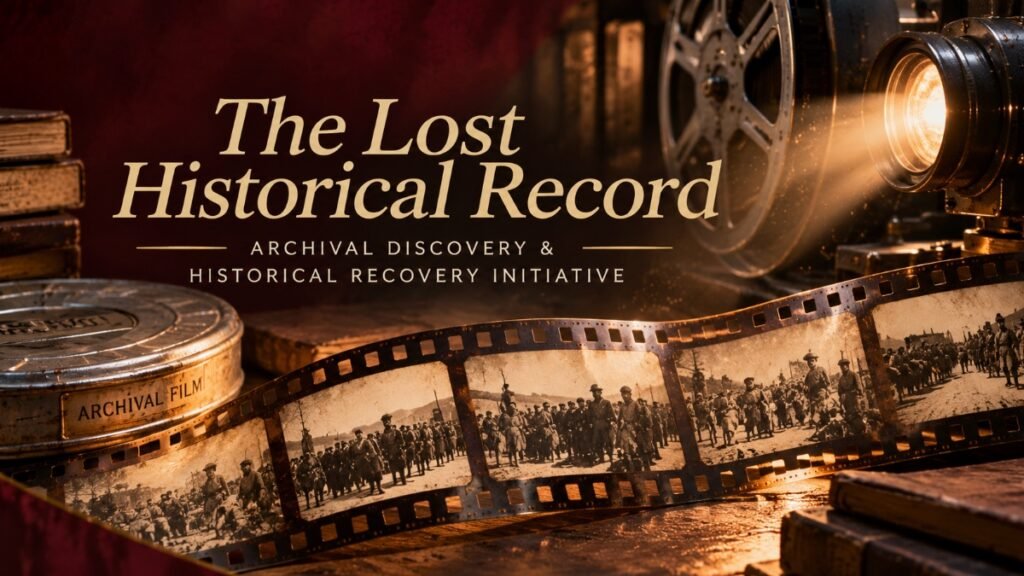
The museum catalogues this sequence as Railway arrival (1919). It comes from the first of two reels associated with the American Military Mission to Turkey and Armenia. In The Lost Historical Record, the clip has a place of its own on an illuminated inspection table. Its catalogue entry takes you back to the reel, where the railway scene belongs to a longer journey.
Thirty-six seconds beside a train
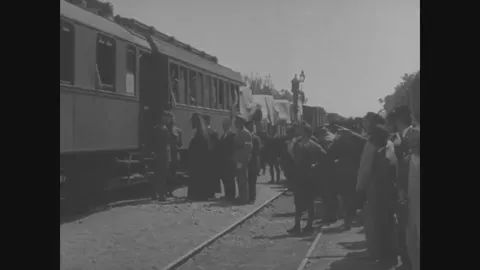
Start at the archival cinema or go straight to the catalogue and search for Railway arrival. Play the sequence in the screening room. Then use the still-frame control and give the image the time it rarely gets when a film is running. Look at how the camera places the carriages in relation to the people. Think about what a travelling mission might have wanted to record at a railway stop.
The catalogue identifies the sequence, dates the footage to 1919 and names the holding archive. It gives you somewhere to take questions that the frame alone cannot settle. What was the exact location? Who was waiting there? What did the people in front of the camera make of the visit?
Follow Reel 1 at the U.S. National Archives. Back at the inspection table, set the railway scene alongside Mountain country and travellers or Town scenes and road travel. One excerpt captures an encounter along the route. The others bring into view the roads, terrain and settlements through which the mission travelled.
Why an American mission was filming in 1919
The American military mission led by Major General James G. Harbord travelled in 1919, in the aftermath of the First World War and during the years of the Armenian Genocide. Its work was a government inquiry. The report addressed transport and communications alongside questions of population, public health and government. Transport was among the things the delegation had been sent to understand.
Open the mission’s report at the Library of Congress and put it alongside the footage. The report sorts what the mission learned into subjects Washington could consider. The camera preserves a particular gathering, on a particular stretch of railway, for as long as the reel runs. Read together, they help explain why roads and railways appear so often in the collection.
Over 1.5 million Armenians were killed during the Armenian Genocide. Ottoman authorities uprooted Armenian communities and forced people onto deportation routes, including into the Syrian desert. As you watch a delegation record rail travel, town streets and formal receptions in 1919, keep the chronology in view. The mission was passing through a region where Armenian families had already endured years of destruction and displacement.
Three reels, three ways in
The inspection table brings together 29 catalogued sequences. The two 1919 reels account for 25. Four further sequences come from reel MVTN 4086, preserved by the University of South Carolina’s Moving Image Research Collections. The museum keeps the source and reel identifiers attached to the excerpts so readers can follow them back.
Reel 1 · 14 sequences. Start here for railway travel, landscapes, roads and settlements. Pair Railway arrival with Motor transport and bridge to see how different kinds of transport enter the mission’s visual record.
Reel 2 · 11 sequences. Start here for assemblies, receptions, street processions and the built environment. Compare the way the camera records people at a public reception with the time it gives to buildings and fortifications.
MVTN 4086 · Four sequences. Search for Presentation of an inscribed textile. The catalogue places it between a conversation on a terrace and a closing group scene. Watch the surrounding clips to see how the presentation fits into the gathering, then pause on the lettering of the textile itself.
Bring an Armenian voice into the room
After watching the film, spend time in the museum’s Survivor Testimonials. Choose one Armenian account and stay with the places and relationships the speaker remembers. A delegation’s camera follows the route of an inquiry. A survivor may remember a route by who walked it with them, who disappeared along the way or where a family found a place to begin again.
For teachers and families, that pairing can open a conversation. Watch a short clip together and write down what can be seen. Read its catalogue entry, then listen to an Armenian survivor’s account. Ask what each source makes possible to learn and whose perspective guides it. When you share a clip, keep its title and reel reference with it so the next viewer can find the original.
Start with the railway scene
Enter The Lost Historical Record, search for Railway arrival and watch the thirty-six seconds through once. Then pause on the people beside the train. The inspection table is there whenever you want to return to a frame and stay a little longer.