The Never Again Journal · Language, memory and cultural survival
A language survives.
A library opens its doors.
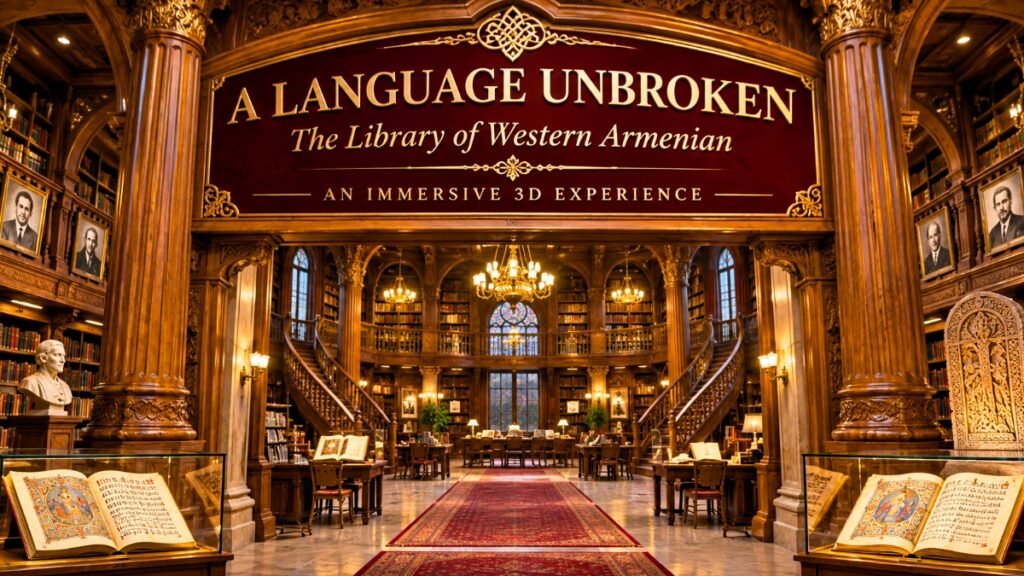
Beyond the doors of a grand library, beneath towering bookshelves, illuminated manuscripts and the portraits of generations of Armenian writers, lies a new immersive experience dedicated to the preservation of Western Armenian.
Developed by the Armenian Genocide Museum of Canada, the Library of Western Armenian brings literature, language, history and cultural memory together within an extraordinary interactive 3D environment.
01 / Beyond the exhibition
Walk into a world of Armenian literature
Imagine entering a vast library framed by carved wooden columns, grand staircases, Armenian khachkars and shelves extending across two floors. Chandeliers illuminate the central hall. Portraits of prominent Armenian writers overlook the galleries, while books, manuscripts and interactive learning stations await discovery.
Rather than navigating a conventional collection of webpages, visitors can now walk through a dedicated architectural space, approach historical works, open books, listen to recordings and participate in language-learning activities.
The Library of Western Armenian is the latest immersive expansion of Exhibit I — A Language Unbroken, an exhibition dedicated to Armenian linguistic heritage and the preservation of Western Armenian across generations.
Every area of the library offers a different encounter with the language. A staircase leads towards literary collections. A reading lounge invites visitors to sit and open a volume. Elsewhere, the written Armenian alphabet becomes something to explore, practise and understand.
The architecture is an integral part of the experience, creating a setting in which the visitor can spend time with the language and the cultural inheritance it carries.
02 / The inheritance of a displaced people
What survives when a world is destroyed?
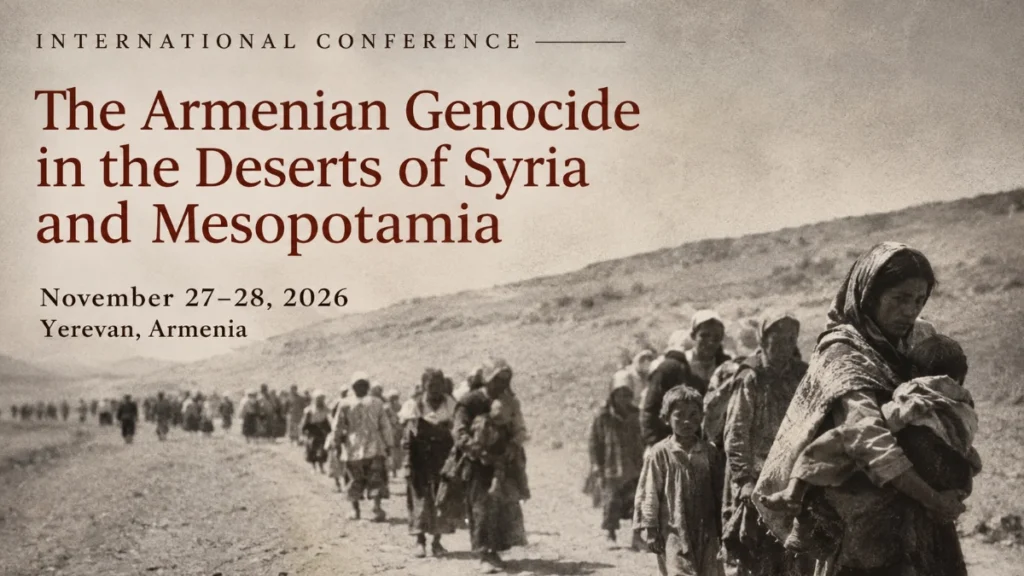
The Armenian Genocide of 1915–1923 claimed the lives of 1.5 million Armenians. Alongside this immense human loss came the destruction of communities, schools, churches, cultural institutions and generations of intellectual life.
Western Armenian had been spoken across Armenian communities of the Ottoman Empire. It was a language of education, journalism, literature, commerce, family life and intellectual exchange.
The deportations, massacres and displacement of Armenians fundamentally transformed the environments in which the language had developed. Survivors carried their words, stories and traditions into new countries, establishing communities throughout the diaspora.
Understanding this inheritance also requires understanding the world that preceded the Genocide. The museum’s Armenian Life Before 1915 interactive atlas explores the communities and institutions that formed part of that historical landscape.
Western Armenian remains a living language. Its continued transmission, however, depends on opportunities to hear it, read it, speak it and pass it on.
03 / The literary inheritance
Among the voices of Armenian literature
Within the library, visitors encounter the portraits and writings of some of the most significant figures in Western Armenian literature.
Daniel Varoujan, Siamanto, Krikor Zohrab and Ruben Sevak represent an intellectual generation whose lives were cut short during the Armenian Genocide. Their surviving writings remain an enduring connection to the literary world from which they emerged.
Other figures, including Hagop Baronian, Bedros Tourian, Misak Medzarents, Srpouhi Dussap, Zabel Yesayan, Sibil, Yervant Odian and Vahan Tekeyan, reveal the remarkable diversity of Armenian literary expression.
Through poetry, satire, fiction, social commentary and personal testimony, these writers explored the complexities of Armenian society, identity, injustice, love, exile and human experience.
Open a book. Encounter its original language.
The library brings together original Western Armenian literary works, allowing visitors to open complete historical volumes and discover the language through the writings themselves.
Among the collections are Hagop Baronian’s satirical works, the poetry of Misak Medzarents and Bedros Tourian, writings by Ruben Sevak, the literary works of Vahan Tekeyan and Srpouhi Dussap’s novel Siranoosh.
These volumes offer a direct encounter with Armenian intellectual life across the nineteenth and twentieth centuries. Their preservation makes it possible for readers to return to the language in which these ideas were first expressed.
A place to sit and read
Upstairs, the Reading Lounge provides a quieter setting within the library. Visitors can approach the seating, choose a book and immerse themselves in the literary collection.
Surrounded by wooden shelves, historical portraits and warm reading lights, the experience encourages visitors to remain with a work rather than simply pass through a display.
Inside the Library of Western Armenian
Four ways to encounter a living language
- Discover the written word Explore the Armenian alphabet, its distinctive letterforms and the historical development of Armenian writing.
- Learn through participation Practise letters, write in sand, explore vocabulary and interact with Western Armenian language-learning activities.
- Enter the literary world Walk through the galleries, discover prominent writers and open original Armenian books within the library.
- Listen to the voices of history Encounter Western Armenian through recorded readings and historical testimony, accompanied by English translations.
04 / From preservation to participation
A library where language becomes an experience
Preserving books is essential. Creating opportunities for people to engage with the language contained within them is equally important.
The Library of Western Armenian extends beyond its literary collections through a series of interactive educational experiences. Visitors can explore Armenian letters, practise writing, discover vocabulary and engage with historical educational materials.
The learning activities provide different entry points for people with different relationships to Armenian. Some may recognise the alphabet but wish to strengthen their vocabulary. Others may understand spoken Armenian while having limited experience reading it. For some visitors, this may be their first encounter with the language.
Speak Armenian
Interactive vocabulary activities encourage visitors to explore Western Armenian words and their meanings. The experience allows learners to return repeatedly, encounter new vocabulary and gradually build familiarity with the language.
Writing and the Armenian alphabet
Visitors can explore the forms of Armenian letters through interactive writing experiences, including the opportunity to trace and write letters in sand.
Historical books and the printing-house experience connect these activities to the longer history of Armenian literacy, education and publishing.
Together, these experiences establish a connection between the preservation of historical material and the continued use of Western Armenian in the present.
05 / Listening across generations
When the language carries testimony
Within the Listening Chamber, Western Armenian becomes a means of encountering historical testimony through its original linguistic expression.
The library includes recorded readings from the account of Haig Toroyan, published in 1917 through the work of Zabel Yesayan. Presented in four parts, these readings recount experiences connected to the deportations and atrocities of the Armenian Genocide.
Visitors can listen to the Western Armenian narration while following the accompanying English translation in an interactive open-book presentation.
For those who understand Western Armenian, the recordings offer access to the language of the historical account. For those who do not, the translation opens another path into the testimony while preserving the presence of its original words.
This experience complements the museum’s Survivor Testimonials exhibition, where individual accounts preserve the experiences of those who witnessed and endured the Genocide.
Language is not separate from remembrance. It is one of the means through which remembrance reaches subsequent generations.
06 / An invitation to discover
Choose your own journey through the library
There is no single prescribed route through the Library of Western Armenian. Visitors can explore the grand hall, ascend either staircase, discover the upper literary galleries, enter the Reading Lounge or approach one of the interactive educational stations.
The library’s directory provides shortcuts to its different areas, allowing visitors to move directly towards the subjects they wish to explore.
Accessible through a web browser, the experience brings these collections and learning activities into a shared digital space that visitors can return to from across the world.
The library also forms part of the Armenian Genocide Museum of Canada’s broader commitment to immersive historical education, alongside the Armenian Genocide Virtual Museum and the museum’s dedicated digital exhibitions.
For generations, Armenian communities have preserved their language through schools, books, family traditions and cultural institutions. The Library of Western Armenian creates another space in which that work can continue.
Every book opened, every word learned and every historical account encountered becomes an opportunity to carry this inheritance forward.
A language unbroken
Enter the Library of Western Armenian
Walk through its grand halls. Discover the writers whose words endured. Open historical books, listen to the language and explore the cultural inheritance carried across generations.
Continue your exploration