The Never Again Journal · Inside the museum
Step inside.
Choose where history leads you.
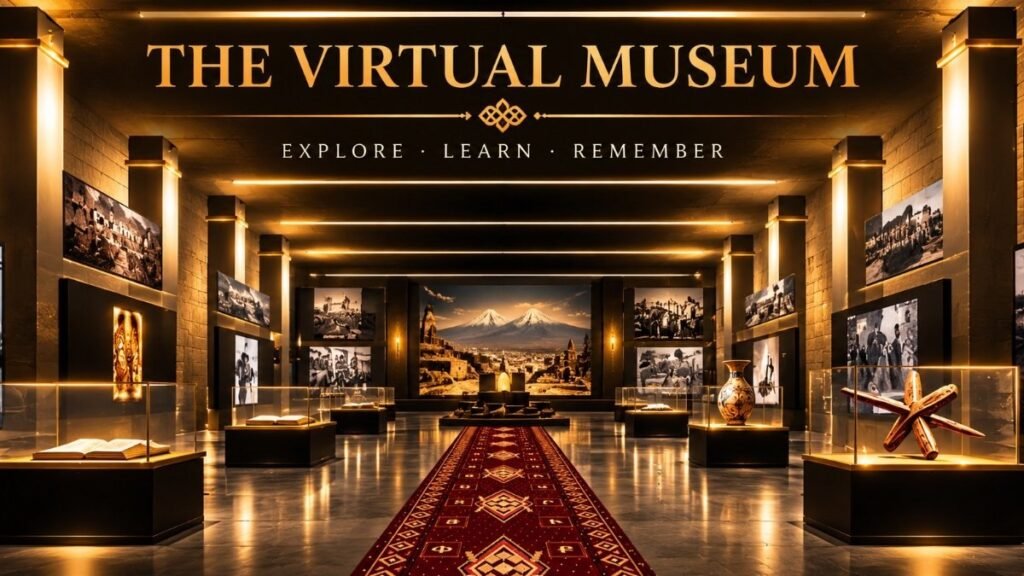
A film station, a survivor’s account, a family object, a language still spoken: AGMC’s Virtual Museum brings nine exhibitions into a shared 3D gallery, giving visitors a new way to discover the histories held within them.
01 / A different way to enter
The museum becomes a place to move through
Most visits to a website begin with a menu. You choose a heading, read a page and decide which link to follow. In the Armenian Genocide Virtual Museum, the first choice is spatial: enter the gallery, look around and move towards something that draws your attention. An exhibition title across the room may lead to a film. A display case may bring you to an object whose significance rests in the family history preserved with it.
This new entrance brings nine AGMC exhibitions into one walkable setting. The architecture gives them a visible relationship: testimony, photographs, material heritage and cultural continuity occupy a common museum space. Visitors can approach them in their own order, pausing at a display or using the Gallery directory to reach a particular subject. The experience rewards curiosity without requiring a fixed route through every station.
The gallery also opens outwards. Selecting an exhibit provides a route to its dedicated exhibition page, where the material can be explored more deeply. That connection is central to the visit. The 3D setting introduces a subject; the exhibition lets a visitor stay with it, read, listen and examine the record at greater length. A first encounter can become the beginning of a much longer investigation.
At the centre of this work is the history of the Armenian Genocide of 1915–1923, in which 1.5 million Armenians were murdered. The museum preserves that history alongside the lives, work, language and cultural inheritance of Armenian communities. Moving between these subjects makes room for both the scale of the destruction and the particular human worlds that must be remembered.
02 / Moving images and the photographic record
Follow a screen into the archive
A film asks for time. Its details arrive in sequence, and the viewer cannot take in everything at a glance. The Virtual Museum includes film displays and dedicated film stations, bringing moving images into the gallery encounter. Visitors can approach a station, use its playback control and continue towards the exhibition associated with it. The physical act of stopping becomes part of the way the material is encountered.
Exhibit A: The Genocide Digital is the museum’s entrance into its film resources. It offers a place to continue beyond a short encounter in the virtual gallery and attend to the films within their exhibition setting. Returning to that dedicated resource allows the visitor to spend more time with moving-image material rather than treating a screen as a passing visual effect.
Still photographs invite another kind of attention. A face, a line of people, clothing, a railway carriage or the arrangement of a relief setting may prompt questions that need patient examination. The Virtual Museum presents framed photographs and links to Exhibit H: The Photographic Archive. The archive’s thematic rooms offer a further route into deportation, children, survival and humanitarian relief.
For visitors, a useful starting point is to choose one photograph rather than attempt to absorb the whole archive immediately. Read its identification, look closely, then follow the surrounding material. A photograph’s power often lies in the details that a quick glance misses. The exhibition connection makes it possible to move from recognition of an image to a more considered encounter with its historical setting.
03 / People remain at the centre
A voice is more than an illustration of history
Testimony changes the pace of an encounter. A survivor’s account brings a name, a voice and a remembered life into the foreground. The Virtual Museum connects visitors to Exhibit D: Survivor Testimonials, whose resources include memoirs, recorded interviews and accounts preserved through historical collections. These different forms make it possible to return to an individual story through more than one kind of record.
The dedicated exhibition introduces figures including Aurora Mardiganian and Karnig Panian, and points readers towards oral-history collections and the Aleppo Rescue Home records. A visitor can begin with a name encountered in the gallery and continue into that larger field of testimony. The experience becomes richer when the account is allowed its own pace: who is speaking, what life is being recalled, and how was that account preserved?
Women’s experiences have a distinct place in this shared setting. Exhibit B: Women & the Genocide brings together writing, witness, persecution, survival and humanitarian action. Its presence beside the other exhibitions makes women’s words and experiences part of the visitor’s route through the museum, with a dedicated place for further reading.
From the gallery case to the family record
Material objects offer another point of contact. A sewing implement or a ceramic vessel can draw attention through its form, but its meaning develops through the information preserved with it. The Virtual Museum’s heritage displays include Mariam Khachigian Azilazian’s sewing implement and a Jerusalem Armenian ceramic vase. Their labels lead towards the museum’s Exhibit F: Artifact Collection, where visitors can explore the objects within their museum context.
The sewing implement is especially closely connected to AGMC’s own story. The museum identifies it with Mariam Khachigian Azilazian and preserves its place in her family’s history of survival. In the gallery, a modest object receives the space and attention usually associated with a formal museum display. Its value emerges through the relationship between a surviving thing and the people who kept its history.
Exhibit C: Museum in a Canadian Home develops that relationship from another direction. It introduces the domestic setting in which family memory and museum work meet. Placing this exhibition within the Virtual Museum connects a public digital visit with the quieter work of keeping objects, photographs and memories across generations.
A visit can begin in different places
Three routes into the gallery
- Begin with a personApproach Survivor Testimonials, then follow one account into its dedicated exhibition. Let a name guide the next part of your visit.
- Begin with an objectLook at a heritage display, read its identification and continue into the Artifact Collection to explore the history attached to it.
- Begin with a communityChoose Armenian Life Before 1915 and continue to the atlas, where places and institutions provide a starting point for understanding what was lost and what is remembered.
04 / Armenian life and cultural continuity
There was a world before the destruction
The gallery’s historical range matters. A museum devoted to the Armenian Genocide must also make the life of Armenian communities visible: their institutions, learning, cultural practices and relationships to place. Exhibit G: Armenian Life Before 1915 provides this route through its interactive atlas. Visitors can leave the gallery for a closer exploration of communities rather than encountering them only through the circumstances of their destruction.
The atlas is a growing work in progress. Historical research continues, and further locations and records will be added. That continuing development is part of its purpose: to bring more of the Armenian world into view over time. A visitor can return to the resource as its coverage develops, using the records already assembled as the beginning of further reading and exploration.
Language gives that continuity a living form. Exhibit I: A Language Unbroken connects the gallery to Armenian letters, literary reading and Western Armenian listening. Its dedicated exhibition includes an alphabet, writing activities, historical books and a literary library. A visitor might begin with a letter, open a volume or spend time listening to the language in use.
These are different kinds of encounter. A letter invites participation; a book invites sustained reading; a recording asks the listener to attend to sound and rhythm. Together they place cultural preservation within reach of the visitor. The next step can be small and specific: learn one form, listen to one passage or return to a text that deserves more time.
Another entrance into investigation
The Virtual Museum also connects to Exhibit Ω: Investigation & Restoration. Its presence gives visitors another route into the museum’s exploration of historical imagery, interpretation and interactive presentation. Following the exhibition link opens that subject in its own setting, alongside the other paths through film, testimony and objects.
The value of bringing these exhibitions together lies in the connections a visitor can make. An interest in writing may lead to a survivor’s account. An object may lead to a family story, and that story to a place in the atlas. The gallery provides a shared point of departure while each exhibition retains the material that gives its subject depth.
05 / Make the visit your own
How to explore
Open the Virtual Museum and select Enter the Museum. On a computer, use WASD or the arrow keys to walk and drag to look around. Double-click to approach a display; on a touch device, tap twice. On-screen directional controls offer another way to move. Selecting a display opens its information and a link to explore the associated exhibition.
| What you want to do | Where to begin |
|---|---|
| Move through the gallery | WASD, arrow keys or on-screen directional controls. |
| Change your view | Drag to look around; double-click or tap twice to approach. |
| Find a particular exhibition | Open the Gallery directory and choose the exhibition. |
| Read beyond a display | Select its information panel and follow Explore exhibition. |
| Return to the website | Use Exit Museum, or open an exhibition directly from the website menu. |
The experience runs in a browser on computers, tablets and mobile devices and needs JavaScript and WebGL-capable graphics. The individual exhibition pages remain available directly, giving visitors a choice of how to reach the museum’s material. For a first visit, select one subject that interests you and follow it beyond the gallery. There is no need to cover every exhibition in one sitting.
AGMC’s Virtual Museum creates a new entrance into an existing body of remembrance and educational work. The invitation is to move, discover and then stay with something long enough to understand it more fully. A voice, an object or a page can become the reason to return.
Your visit begins here
Enter the Virtual Museum
Walk through the gallery, choose an exhibition and follow the history that holds your attention.
Exhibition guide
Continue with the museum’s collections
This visitor feature draws on the Virtual Museum’s current exhibition directory, display identifications and visitor controls, together with the dedicated AGMC exhibitions linked throughout the article. Those exhibition pages provide the next step into their collections, historical accounts and source references.
For a broader view of the questions behind the collections, visit AGMC Research. It brings together studies that can be read alongside a gallery visit and returned to as an interest develops.