The Never Again Journal · Inside Exhibit I
A letter to trace.
A literature to return to.
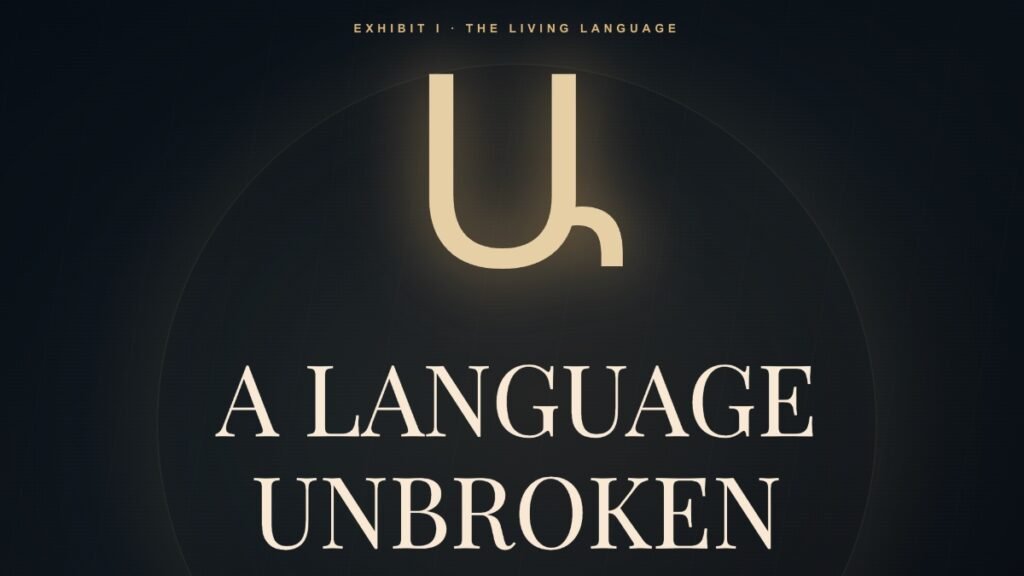
A Language Unbroken brings Western Armenian into an interactive museum setting: an alphabet to explore, books to open, testimony to read and hear, and words to practise. Its invitation begins with something small enough to fit beneath a fingertip.
Enter A Language Unbroken ↗01 / A museum encounter with a living language
Begin with one letter
The first decision is a letter. Select one in the alphabet gallery and the exhibition displays its name, uppercase form and lowercase form. A further step takes that selection into a digital sand surface, where a visitor can trace it, reveal a guide, clear the drawing and begin again. Reading and movement belong to the same encounter.
This is the starting point of A Language Unbroken, Exhibit I at the Armenian Genocide Museum of Canada. The exhibition is available online and brings together language activities, historical reading, a Western Armenian literary library and a listening edition. Visitors can follow its galleries in sequence or use the navigation to return to a particular room. There is no requirement to arrive already able to read Armenian.
For someone who knows the language, the forms may be familiar. For someone encountering Armenian writing for the first time, selecting and tracing a single letter offers a manageable beginning. A family can look at the same screen with different kinds of knowledge: one person may recognize a word immediately, while another needs the English meaning or pronunciation guide. The exhibition makes room for both kinds of visitor.
The sand activity is a contemporary act of participation. It should be understood as an invitation to practise writing and consider the transmission of language, rather than a reconstruction of a particular survivor’s experience. Its significance lies in a simple relationship: a mark needs a person to make it, and learning requires another attempt.
Why language belongs in a museum of the Armenian Genocide
During the Armenian Genocide, 1915–1923, 1.5 million Armenians were murdered. The destruction of communities also tore apart the settings in which people learned, read, wrote and spoke together. A language exhibition approaches that history through what Armenian people created and what survivors and later generations continued to carry.
The starting point is therefore more than loss. Armenian words belonged to homes, schools, books, religious life and public debate before the Genocide. They remain part of living communities. The museum’s growing Armenian Life Before 1915 — Interactive Atlas offers a complementary way to investigate those communities and institutions. Its expanding geographical records give another setting for the language encountered here.
The Calouste Gulbenkian Foundation’s Armenian Communities Department identifies Western Armenian as an endangered language and describes work across education, publications, technology and digitisation to sustain its use. That context helps explain the value of accessible language resources. Preservation involves keeping opportunities to read and use a language within reach, as well as safeguarding older material. [2]
02 / Open a book, then look more closely
Two reading rooms, different encounters
The exhibition’s classroom introduces a book on a museum-style podium. Nearby, the historical reading room presents Հայկական տպագրութիւն (Armenian Printing), identified in the exhibition as Leo’s 1904 work. Opening a historical volume changes the pace of a digital visit. Instead of moving immediately to the next summary, the visitor can remain with pages of Armenian print. [1]
A scanned page retains things a short description cannot reproduce: the arrangement of lines, the relationship between headings and text, and the appearance of the printed script. Even a visitor who cannot yet read the passage can notice how the book was organized. A reader who knows Armenian can go further, attending to the words themselves. The same object supports different degrees of familiarity.
The historical context reaches back well before this particular book. The Library of Congress dates the first Armenian printing press to Hakob Meghapart’s work in Venice in 1512 and identifies Urbatagirk, The Book of Fridays, as the first printed Armenian book. Its account follows the expansion of Armenian print into scholarship and multiple fields of learning. [3] The exhibition’s virtual printing activity offers a small practical connection to that larger history: visitors select an Armenian word and create a digital keepsake.
Alongside the historical reading room, the Western Armenian Literary Library presents six writers: Zabel Yesayan, Siamanto, Daniel Varoujan, Sibil, Krikor Zohrab and Yervand Otyan. The shelf links to individual volumes, including Yesayan’s Among the Ruins and Otyan’s National Benefactor. This arrangement invites a visitor to choose a writer and open a work rather than encounter six names as a closed list. [1]
A shelf is also an invitation to read women
Yesayan and Sibil belong within this literary setting. Their presence makes women’s writing part of the exhibition’s reading experience, with books to open rather than names placed at its margins. Visitors interested in this connection can continue to the museum’s Women Writers and Eyewitnesses section.
Yesayan’s Among the Ruins also requires a clear historical distinction. The Armenian Genocide Museum-Institute records her journey to Cilicia after the Adana massacres of 1909 and the publication of the work in Constantinople in 1911. It describes her later work documenting eyewitness accounts after she escaped arrest in 1915. [4] The 1909 massacres and the Armenian Genocide of 1915–1923 are connected historical subjects, but their dates should remain distinct.
Reading her work alongside other volumes encourages questions that a display of portraits alone cannot answer. What kind of writing is being encountered? Who is speaking? When was the work composed or published? A poem, a novel, a collected edition and an eyewitness account ask different things of a reader. The museum’s Books and Literature resource provides a further route into texts and documentary collections.
Different forms of continuity
From a page to a voice to a word in use
- RecognizeChoose an alphabet character and compare its uppercase and lowercase forms.
- ReadOpen a historical book or select one of the literary library’s six writers.
- ListenFollow a Western Armenian reading alongside the original text, keeping its modern narration distinct from the historical account.
- PractiseUse the word activity or virtual printing house to return language to an action.
03 / Reading and listening with attention
The historical words and the modern recording
A dedicated listening section presents Chapter 6 of Ժողովուրդի մը հոգեվարքը, The Agony of a People, attributed on the exhibition page to Haig Toroyan and documented by Zabel Yesayan. It divides the chapter into four parts, with audio controls and expandable original Western Armenian text. The subject matter includes deportation and the suffering and murder of Armenian civilians; visitors should approach this section with care. [1]
The distinction between the account and its delivery is essential. The exhibition labels the audio as computer-generated Western Armenian narration. It is a modern reading of a historical text, not an original recording of Toroyan, Yesayan or a survivor speaking. Keeping the text available beside the audio lets a visitor return to the written words rather than rely on sound alone.
This paired presentation can support close reading. A visitor can pause after a passage, open its text and consider a name or place before continuing. It also leaves room for different needs: one person may prefer listening, another may want to read, and another may use both. Availability in more than one form broadens the ways into a difficult document without changing who supplied the historical account.
For a wider encounter with personal accounts, continue to Exhibit D: Survivor Testimonials. Readers interested in how accounts become part of a historical record can also explore Documenting the Crime. These resources deepen the connection between language, a named person and the circumstances in which an experience was recorded.
04 / Choose a route through the exhibition
There is more than one place to begin
A first visit need not cover every gallery. Someone beginning Armenian can stay with the alphabet and a few words. A reader may head directly to the literary shelf. Someone researching testimony may spend most of the visit with the original-language text. The gallery navigation makes those different approaches possible.
| If you want to… | Begin here | Try this next |
|---|---|---|
| Encounter the script | The living alphabet | Select one character, inspect its two forms and trace it in sand. |
| Spend time with a book | The historical reading room or literary shelf | Notice the title and author before moving into the pages. |
| Follow an account in Western Armenian | The four-part listening edition | Open the original text and pause between sections. |
| Practise a word | Speak Armenian | Read the meaning and pronunciation guide, then return to the Armenian spelling. |
Speak Armenian displays words with English meanings and pronunciation guides, with controls for listening and moving between entries. Its sound spellings are approximate guides, as the exhibition notes. They provide an entry point for a visitor using English, while the Armenian writing remains visible. The activity is best approached as practice and exploration, rather than a promise of fluency from a museum visit.
The printing house offers another short encounter. A visitor chooses from words such as light, home, hope, love and mother, then creates a virtual printed keepsake. These ordinary meanings are part of the point. A language’s continued life includes the familiar things people say and read, alongside the historical documents through which its past can be studied.
05 / Beyond a single visit
What it means to carry language forward
A digital exhibition cannot replace the many relationships through which a language is learned and sustained. It can make a book easier to encounter, put an Armenian word within reach of a new reader and provide a reason to return. Those are specific, useful contributions to preservation.
For a Canadian museum, these questions also connect to the histories of Armenian survivors who built lives here. The Georgetown Boys feature examines language and memory in a Canadian setting. Canada’s Response exhibit offers the broader humanitarian context. Neither substitutes for the language exhibition; together, they allow visitors to move between individual learning, historical experience and remembrance.
A family book, letter or school document may carry another connection. Keeping known names, dates and the item’s history with it can help preserve that connection for later readers. The museum’s Contribute an Artifact page explains how to begin an enquiry about relevant material.
A Language Unbroken gives visitors several ways to enter the subject without asking them to know everything first. Choose a letter. Open a volume. Read a passage at its own pace. The exhibition’s value emerges through those encounters with Armenian writing as something made, remembered and still used.
Visit Exhibit I
Return to the words themselves
Sources and further reading
Exhibition and historical references
- Armenian Genocide Museum of Canada, Exhibit I: A Language Unbroken. Source for the exhibition’s galleries, listed books, activities and audio labelling. The exhibition continues to develop; available content and controls may change.
- Calouste Gulbenkian Foundation, Armenian Communities Department, The Western Armenian Language. Context on language vitality and preservation approaches; no institutional partnership with AGMC is implied.
- Library of Congress, “To Know Wisdom and Instruction”: The Armenian Literary Tradition, exhibition overview. Source for the 1512 press, Meghapart and the early printed-book context.
- Armenian Genocide Museum-Institute, Zabel Yesayan: For the Sake of the Armenian Orphans. Source for Yesayan’s 1909 journey, the 1911 publication and subsequent documentary work.