
Exhibit F / The Artifact Collection
What a family
carried forward.
A photograph. A wooden tool. The people and histories held within ordinary things.
Explore the exhibit ↓
A family photograph or a small wooden tool can outlive the person who protected it. Its survival gives later generations something tangible to encounter, but an object cannot explain its own journey. The names, recollections and documents kept with it are part of its history.
This exhibit begins with material already presented in AGMC’s Museum in a Canadian Home. It introduces those objects through the museum’s published family account and explains how provenance helps preserve their meaning. It also points to a clearly identified example held by another museum.
The Armenian Genocide left 1.5 million Armenians murdered. Objects connected with survivors and descendants carry fragments of lives and communities that violence sought to destroy. Their value cannot be measured only by age, rarity or price.
A wooden sewing tool
Associated with Mariam Khachigian Azilazian in AGMC’s published family account.
- Material
- Wood
- Date
- Not established in the published account
- Record
- AGMC family history, Exhibit C
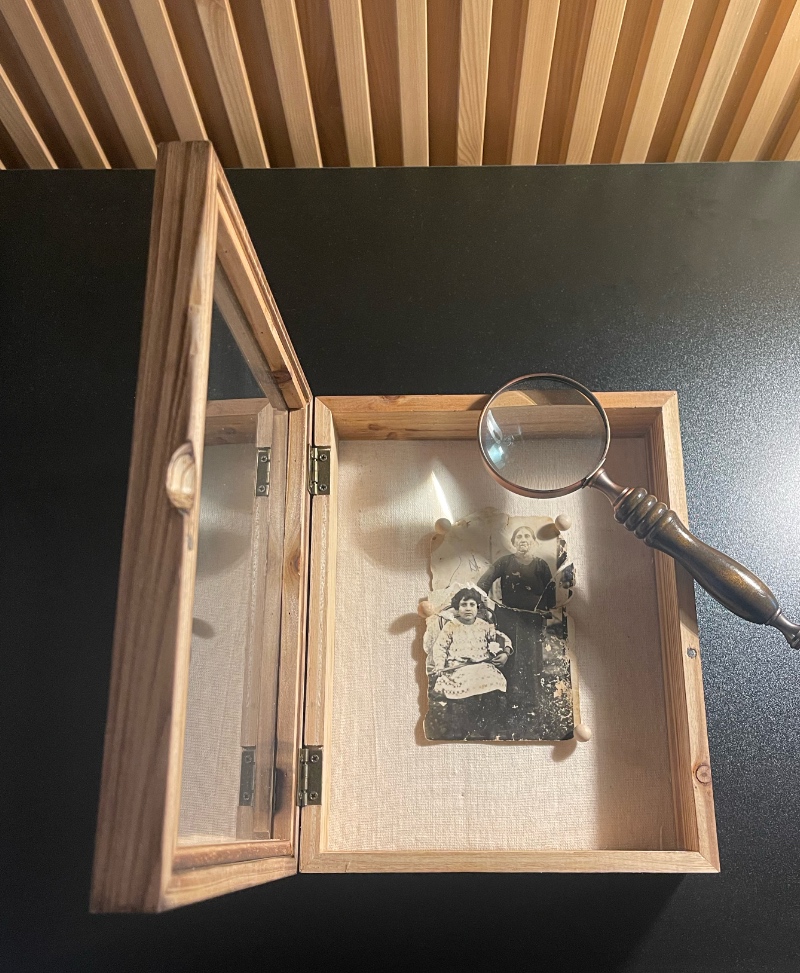
Mariam and Vartanoush
A family photograph identified by AGMC’s existing account, shown here in its museum display.
- Format
- Photograph in a display case
- Identification
- AGMC’s published family account
- Original date
- Not established on this page
A wooden sewing tool connected with Mariam Khachigian Azilazian
AGMC’s published founding account identifies a hand-carved wooden sewing tool among the family objects associated with Mariam Khachigian Azilazian. The account traces the tool and a photograph through the family to museum founder Bernard Kradjian, describing their role in inspiring the museum.
The tool connects remembrance with the material world of everyday life. Sewing belongs to work, clothing, households and skills passed between people. An object associated with that work invites attention to a survivor’s life beyond the moment of violence.
The museum’s account also states that the precise way these belongings survived remains unknown. That uncertainty should remain part of the description. The tool should not be assigned an exact manufacture date, maker or route through deportation without supporting evidence.
Read the full family account and view the existing object photographs in Exhibit C.
The photograph of Mariam and Vartanoush
The same exhibit identifies a photograph of Mariam and her daughter Vartanoush Azilazian. In the family history presented by AGMC, Vartanoush was abducted during the Armenian Genocide and never seen again. The photograph is described there as her last known image.
That attribution matters. The description comes from the museum’s published family account; it is not a newly discovered identification or a claim that this page has independently reconstructed the photograph’s original date and setting.
A family photograph can preserve the relationship between two people even when later events have shattered the family around them. Naming the people shown keeps the image from becoming a generic illustration of suffering. Recording who supplied the identification helps future researchers understand its basis.
What provenance means
Provenance is the recorded history of an object: who made or used it when known, who kept it, how it changed hands and how it reached its present custodian. A complete history is not always recoverable. A clear statement of what is known is more useful than an attractive story that fills every gap.
Different kinds of information should be kept together without being confused. A dated inscription is one form of evidence. A recollection supplied by a relative is another. A later museum description explains how the material has been interpreted. Each can be recorded with its source.
For a photograph, preserve information from the reverse, any album context and the names supplied by family members. For an object, record inscriptions, associated letters and the identity of the people who remember its use. Do not infer an exact date solely because an item looks old.
A comparative object record: an orphanage-made rug
The Armenian Museum of America presents a “Tooth Rug” made in Near East Relief orphanages in Lebanon. Its collection description identifies the rug as on loan from the American Dental Association. That combination of an object’s making, institutional history and current custody shows why a good catalogue entry includes more than a title.
Explore the Armenian Museum of America’s object record. The rug is an external collection example, not an AGMC holding. Its history should not be transferred to a different rug or textile merely because the objects appear similar.
Objects carried into the Diaspora
Objects can acquire additional meanings after a family resettles. A photograph may be displayed in a Canadian home, explained to children and later used to introduce a family history to visitors. An inherited tool may become a reason to ask about the person who once kept it.
These later lives of an object are worth documenting too. Preservation includes the decisions of descendants: who protected the material, who supplied names and who recognized that it could speak to a wider public. The history of the Armenian Diaspora includes those acts of transmission.
Sharing information with AGMC
Families holding relevant photographs, letters, documents or objects can begin with Contribute an Artifact or the museum’s contact page. An initial enquiry can describe the material, its connection to the family and what is known about its history.
Include uncertainties as well as established details. If relatives remember different names or dates, preserve those accounts rather than choosing one without evidence. A careful record can leave a question open for future research.
Please discuss any physical transfer with the museum before sending original material. Enquiring about an object does not itself establish acceptance, ownership transfer or a display arrangement.
Follow the history further
Continue to Women & The Genocide for the experiences surrounding many family records, or explore survivors’ work as record keepers. Return to all exhibits to choose another path.