
Women & The Genocide / Archive 03
Across an ocean.
A duty to remember.
Canadian care, Armenian survival, and the women who kept memory alive.
Explore the exhibit ↓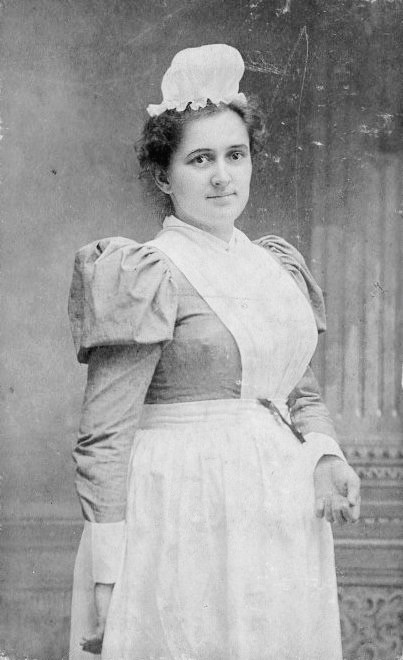

A nurse from Nova Scotia carried her skills into a world of displaced Armenian families. Armenian women who survived carried something different into Canada: memories, family histories and the responsibility of rebuilding lives after destruction. Their experiences belong together in the history of remembrance, without confusing the person who offered assistance with the person who endured the crime.
The Armenian Genocide left 1.5 million Armenians murdered and survivors facing the loss of relatives, homes and communities. This archive begins with a documented Canadian relief worker, Sara Corning, and follows the record toward Armenian women’s own lives in Canada. It is a starting point for exploring named people and identifiable sources.
Sara Corning: from Chegoggin to relief work
Sara Corning was born in Chegoggin, Nova Scotia, in 1872. The Sara Corning Centre’s biography records her nursing training in the United States, American Red Cross certification in 1918 and arrival with Near East Relief in 1919. Her work took her to the Republic of Armenia and later Anatolia, amid severe deprivation and disease.
In September 1922, Corning was part of a medical team in Smyrna as people crowded the city seeking escape. The Centre describes her and her colleagues leading children from two schools to ships during the destruction. She subsequently worked in orphanages in Greece and supported the education of five girls she adopted.
These episodes place practical care at the centre of her contribution. Nursing, evacuation and sustained support for children required work beyond a single rescue. Her story is preserved by institutions in Nova Scotia and by the Toronto-based education centre bearing her name. Read the Centre’s account of Corning’s life.
What a nursing record can show
A relief worker’s biography can identify journeys, assignments and institutions. A photograph may preserve the faces of a group whose names need further research. A letter can show what one observer knew at a particular moment. Read together, such records make humanitarian work more specific than a general claim that help was offered.
The Nova Scotia Archives hosts a Yarmouth County Museum and Archives record for Corning, identified as PH-51-Corning-20.31. Explore that archival record. Its institutional description should be read alongside the fuller chronology provided by the Corning Centre; a catalogue entry and a researched biography serve different purposes.
Following those references also keeps Canadian assistance connected to the Armenian children and families for whom it mattered. The historical subject is not simply the helper’s courage. It is the survival of people whose lives had been targeted, and the conditions in which they could begin again.
Armenian women arriving in Canada
Canadian relief history cannot be told only through the better-known story of the Georgetown Boys. Historian Daniel Ohanian’s research, presented by the Sara Corning Centre, also examines girls and women who survived the Armenian Genocide and came to Canada between 1923 and 1930. His study places their migration within restrictive immigration policies rather than describing admission as automatic or uncomplicated.
Explore Ohanian’s research on child and women survivors. It provides a route into the experiences that broad national accounts can overlook: the decisions that governed admission, the organizations involved and the refugees whose futures were being negotiated.
For a woman reaching Canada, safety and the work of rebuilding were distinct experiences. A new address could not replace relatives who had been murdered. Learning a language, finding work and maintaining Armenian family memory belonged to the years after arrival. Each person’s experience needs its own evidence; one life should not be made to represent all survivors.
Women preserving the family record
Armenian women’s historical work is also visible in what families kept. Photographs, letters and objects may have survived because someone remembered a name, protected a possession or told a child why it mattered. Those acts can be modest in appearance and decisive in consequence.
AGMC’s Museum in a Canadian Home exhibit describes the family photograph and sewing tool connected with Mariam Khachigian Azilazian that helped inspire this museum. It offers a particular family history, rather than a claim that every surviving object followed the same path.
When a descendant records that history, it helps to distinguish a surviving document from a remembered account. Both may be valuable. Naming the person who supplied a recollection and recording when it was shared make it easier for future generations to understand how the story reached them.
Explore the record
Continue through the museum
Visit Canada’s Response for the broader exhibit, return to Women & The Genocide, or explore the Armenian Diaspora. Families wishing to discuss material they hold can begin with Contribute an Artifact.