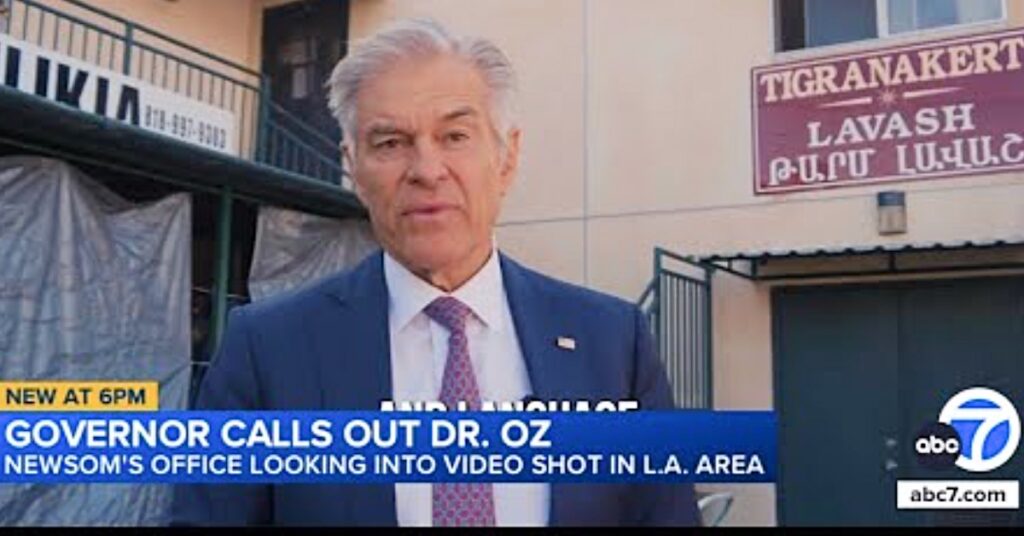
In late January 2026, a social media video released by Dr. Mehmet Oz — the Administrator of the U.S. Centers for Medicare & Medicaid Services (CMS) — sparked widespread concern and condemnation from Armenian-American communities in Southern California and from state leaders, including California Governor Gavin Newsom. In the footage, Dr. Oz appears to drive through predominantly Armenian neighborhoods in Los Angeles, singling out medical facilities and small businesses with Armenian-language signage in connection with alleged hospice and healthcare fraud. Critics say this approach — linking ethnicity and language to criminality without clear evidence — amounts to racial profiling and fuels prejudice against Armenian Americans.
Armenian civil rights organizations, including the Armenian National Committee of America-Western Region (ANCA-WR), have expressed alarm that such rhetoric undermines constitutional standards and risks stigmatizing an entire community. They note that while fraud is a serious issue that must be addressed, enforcement efforts must be grounded in individualized evidence and due process, not ethnic generalizations.
Why This Matters: Armenophobia and Historical Context
For Armenian Americans — many of whom are descendants of genocide survivors who immigrated to the United States over the last century — history informs how such messaging is received. Generations have lived with the legacy of denial, erasure, and dehumanizing portrayals that preceded the 1915 – 1923 Armenian Genocide. Targeting communities based on cultural markers or language echoes long-standing patterns of prejudice that have serious real-world consequences for civil rights and social cohesion.
Even when the individual intentions behind enforcement are to protect public programs, the optics of linking entire neighborhoods and businesses to wrongdoing — particularly when language or ethnicity is emphasized — can create an atmosphere of mistrust and fear. According to community advocates, this is especially striking when a government official publicly associates business ownership or cultural identity with criminality without verified, individualized evidence.
Armenian Americans’ Contributions to the United States
Over the last century, Armenian Americans have played a meaningful and often under-recognized role in shaping the social, scientific, and economic life of the United States. From small, family-run businesses that anchor local neighborhoods to contributions at the highest levels of medicine, science, and public service, the Armenian diaspora reflects the full spectrum of American civic life.
Armenian Americans have been pioneers and leaders in fields ranging from healthcare and engineering to technology and biomedical research. Armenian scientists and physicians have contributed to foundational medical advances, including early MRI development and vaccine research, and Armenian-American professionals have played roles across academia, pharmaceutical innovation, and public health — contributions that continue into the present, including involvement in modern vaccine and biotechnology efforts.
At the community level, Armenian-owned bakeries, clinics, cultural centers, and professional practices are not merely commercial enterprises; they are expressions of integration, service, and continuity after displacement and loss. Together, these contributions stand in stark contrast to narratives that reduce an entire community to suspicion based on ethnicity, language, or geography.
To frame Armenian-American identity primarily through the lens of alleged criminality — rather than through its century-long record of contribution — risks erasing this history and distorting the public understanding of who Armenians are within the American story.
Deliberate Profiling or Misguided Messaging?
The episode also reignited discussion about Dr. Oz’s background and public statements on Armenian-related issues. Critics have pointed out that Oz is of Turkish descent and has previously been criticized by Armenian advocacy groups for his past stances, including not explicitly recognizing the Armenian Genocide during his political campaigns. While an individual’s heritage should never be used to discredit their entire career or public service, the historical sensitivity of Armenian-Turkish relations adds an additional layer to community reactions.
Whether intentional or not, the use of broad ethnic markers — such as script on storefronts or neighborhood identity — as a shorthand for criminal behavior raises legitimate concerns about civil rights, equal protection under law, and the potential for reinforcing harmful stereotypes.
A Call for Dignity, Evidence-Based Enforcement, and Respect
As discussions around healthcare fraud investigations continue, it is critical that all enforcement efforts uphold the highest standards of transparency, fairness, and non-discrimination. Authorities must ensure that allegations are communicated with accuracy and respect for the dignity of all communities involved.
Public officials — at federal, state, and local levels — carry a responsibility to prevent the spread of narratives that can unintentionally marginalize or stigmatize entire groups. History has shown that unchecked ethnicized messaging can erode trust, deepen social divides, and damage the social fabric that holds diverse societies together.
Armenophobia — like all forms of racial or ethnic prejudice — has no place in civil discourse or public policy. Protecting communities from harm requires nuance, evidence-based investigation, and an unwavering commitment to equality under law.