Before the world learned to name evil with the word Holocaust, the term was already used to describe the annihilation of a Christian people — the Armenians of the Ottoman Empire. In the early 20th century, journalists, missionaries, and diplomats referred to what they witnessed as a Christian holocaust, a catastrophe of biblical scale that destroyed an ancient civilization rooted in faith, art, and learning.
This tragedy — now recognized globally as the Armenian Genocide — became the model for modern genocide itself. Over 1.5 million Armenians were systematically killed during this campaign of extermination. It is also remembered by many as the Armenian Christian Holocaust, a phrase that captures both the ethnic and religious persecution of Armenians and other Christian minorities such as the Greeks and Assyrians. While the suffering of these communities was profound, the Armenian population endured the greatest losses — 1.5 million lives — which is why history recognizes this catastrophe primarily as the Armenian Genocide.
The First Use of “Holocaust” and Its Link to the Armenian Genocide
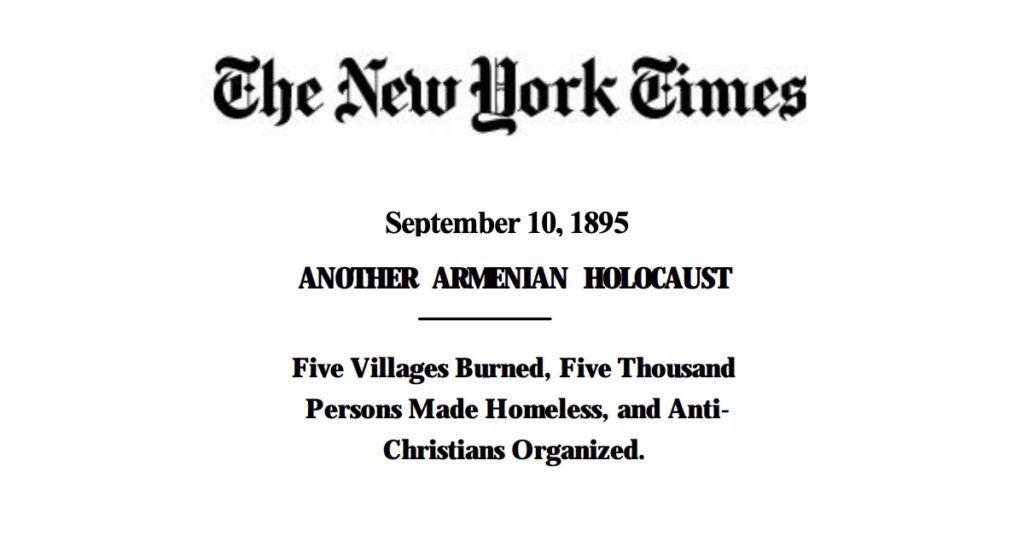
Long before World War II, the term holocaust appeared in English-language newspapers describing the Ottoman massacres of Armenians in the 1890s under Sultan Abdul Hamid II. In 1895, publications such as The New York Times and The London Times referred to the destruction of Armenian villages as an “Armenian holocaust.” After the Adana Massacre of 1909 — when some 30,000 Armenians were killed — Western observers again described it as a Christian holocaust.
Even Winston Churchill would later refer to the 1915–1917 massacres as a “holocaust” in his writings, decades before the term became synonymous with Nazi atrocities. Thus, historically, the Armenian Christian Holocaust was the first event in modern times to which that word was applied.
The Armenian Christian Holocaust: A Campaign of Extermination
Beginning in April 1915, the Committee of Union and Progress (CUP) launched a systematic campaign to remove the Armenian Christian population from its ancestral homeland in Anatolia. Under the guise of wartime security, hundreds of thousands of men were executed outright. Women, children, and the elderly were driven on death marches through the Syrian desert — deprived of food, water, and shelter until they perished.
What the world would come to call the Armenian Genocide was not merely political or military — it was religious cleansing. Armenians were killed as Christians. The Ottoman state mobilized religious rhetoric to justify its campaign, often enlisting local Muslim clerics to declare Armenians gavurs — infidels — whose removal was supposedly an act of faith.
Faith, Fire, and the Destruction of the Church
In many towns, Armenians were gathered into their churches — symbols of a Christian identity stretching back to the 4th century — and the buildings were set on fire. Contemporary accounts describe entire congregations burned alive, priests hanged or beheaded, and sacred relics destroyed or desecrated.
Historians such as Simon Payaslian and eyewitnesses like Ambassador Henry Morgenthau documented how these acts were not isolated. They were coordinated, symbolic attacks meant to erase both the physical and spiritual presence of Armenians from the Ottoman realm.
The burning of churches — often with women and children locked inside — stands among the most horrific images of the Armenian Christian Holocaust. The destruction of hundreds of monasteries and cathedrals severed the link between faith, art, and community that had endured for over 1,700 years.
Forced Conversion and Religious Manipulation
Religion was also weaponized. Muslim clerics were at times directed by local governors or CUP officials to issue proclamations legitimizing the slaughter of infidels. In certain regions, Armenians were given a cruel choice: convert to Islam or die.
Thousands of women and children were forcibly taken into Muslim households, given new names, and raised apart from their culture. This policy aimed not only to depopulate the land but to dissolve the Armenian Christian identity itself — a spiritual genocide that paralleled the physical one.
Beyond Armenians: The Wider Christian Tragedy
The same ideology that targeted Armenians also reached other Christian peoples of the Ottoman Empire. Assyrian and Greek communities were similarly deported, massacred, or forced into flight. Historians estimate that more than 250,000 Assyrians and 350,000 Greeks perished between 1914 and 1923.
Yet because Armenians made up the largest and most widely dispersed Christian minority — and because their extermination was so thorough — the world came to remember this collective catastrophe as the Armenian Genocide, or the Armenian Christian Holocaust.
A Precursor to Modern Genocide
Polish-Jewish jurist Raphael Lemkin, who coined the term genocide in the 1940s, cited the Armenian case as his primary example when defining the crime. The Armenian Christian Holocaust was, in his words, the prototype for all later genocides — a government-directed plan to annihilate a people’s body, culture, and spirit.
The parallels with later genocides — from Europe to Africa — are unmistakable. Deportation lists, death marches, starvation camps, propaganda that dehumanized victims — these all began with the Armenian Christian Holocaust of 1915–1923.
Remembering the Christian Holocaust Today
Recognizing the events of 1915–1923 as both an Armenian Genocide and a Christian Holocaust is not an act of revisionism but of completeness. It acknowledges that Armenians, Greeks, and Assyrians were murdered not only because of their ethnicity but because they were Christians living under an empire that defined them as alien, impure, and expendable.
To remember the Armenian Christian Holocaust is to remember the destruction of faith, community, and history — and to reaffirm that humanity must never again tolerate the weaponization of religion for extermination.
AGMC’s Commitment to Memory
The Armenian Genocide Museum of Canada is committed to preserving the historical truth of the Christian Holocaust of 1915 — the annihilation of Armenia’s Christian civilization, which also engulfed Assyrian and Greek communities across Anatolia.
Through exhibitions, survivor testimonies, and research, AGMC continues to tell the story of the Armenian Christian Holocaust — ensuring that this first genocide of the modern era remains a warning to all generations.